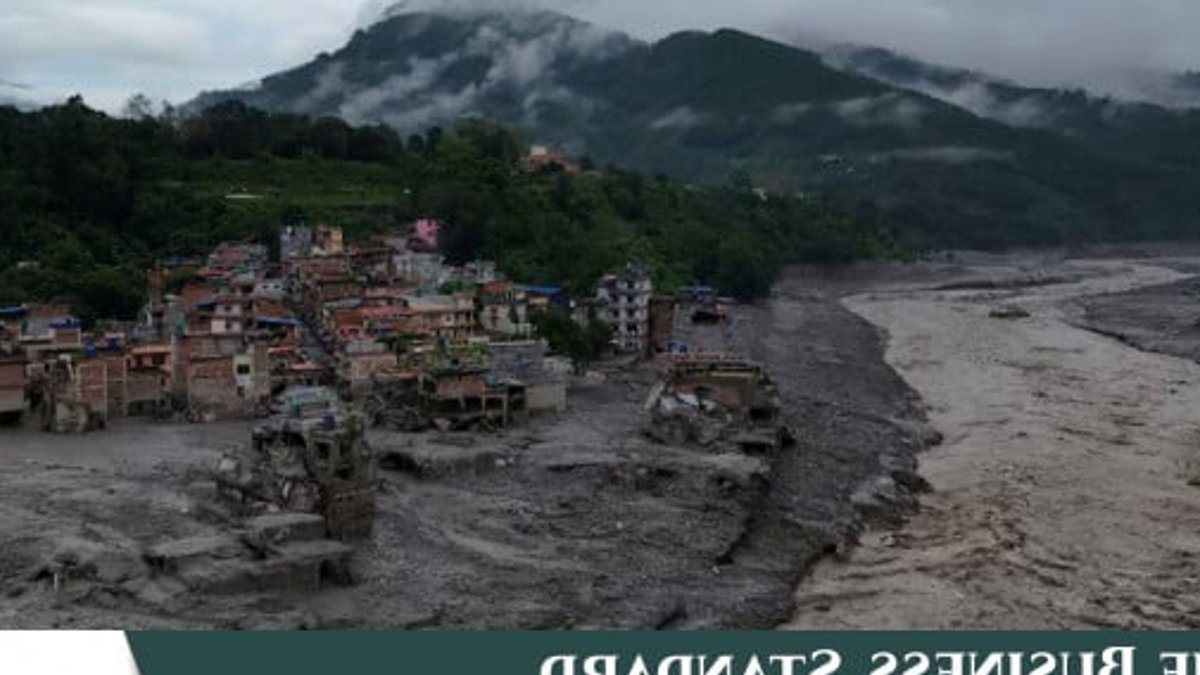
Nearly 1,500 people, including at least 800 foreigners, remain unaccounted for across Nepal and China’s Tibet after a massive mudslide crashed into a Himalayan river, triggering catastrophic floods through towns and valleys.
Rescuers in Nepal deployed helicopters to search for survivors and deliver emergency supplies to thousands stranded in a rugged mountainous region popular with trekkers and pilgrims traveling between Lhasa and Kathmandu.
Floods and Missing Persons
Police confirmed the death toll had reached 165 and warned the number would climb as search operations resumed. “More bodies are expected to be recovered,” police spokesperson Abi Narayan Kafle stated.
Of the 826 people missing in Nepal, nearly 600 were foreign nationals. Tourism officials reported the missing included 177 Indians, 63 Americans, 34 Australians, 33 Britons, and 25 Canadians, among others.
In Tibet’s Gyirong county, 558 individuals were missing, including 260 foreigners, according to state broadcaster CCTV.
Related: Government Rations CNG Boosts Oil Power for Industry
Survivor Accounts
Footage verified by journalists showed torrents of water and debris sweeping away dozens at a border crossing in Gyirong. Homes, roads, and infrastructure downstream in Nepal were destroyed. Keshav Prasad Baral, a 68-year-old survivor receiving hospital treatment, described the moment the flood struck.
“A huge wave of mud rushed toward us. As it neared, it kept rising. When it hit our home, I tried to pull my wife to the terrace, but the current carried her away.” A helicopter rescued him four hours later. “She’s still buried under the mud. She didn’t make it.”
Another survivor clung to a mango tree as the floodwaters demolished the house where he had been working.
Relief Efforts
In the hardest-hit districts, helicopters airlifted tents, food, and supplies donated by India, said Raja Ram Basnet, a spokesperson for Nepal’s army. Over 5,000 military and police personnel joined the search for survivors and victims.
Initial reports suggested an earthquake may have triggered the glacier collapse. The US Geological Survey later clarified that the seismic activity was caused by the rock and ice avalanche itself, followed by debris flow.
Chinese authorities warned of risks from a dammed lake upstream in Gyirong, which could further complicate rescue operations in the remote, mountainous terrain.
Related: Trading Volumes Rise Despite Account Delays
The disaster highlights the dangers of natural events in isolated regions, where difficult access and limited resources hamper relief efforts.
Many victims had been traveling to Kailash Mansarovar, a sacred site in Tibet revered by Hindus and Buddhists. Mount Kailash, believed by Hindus to be the home of Lord Shiva, stands near Lake Mansarovar, another holy location.
The US State Department dispatched a disaster response adviser and allocated $500,000 in aid. Canadian Prime Minister Mark Carney called the floods “absolutely devastating” in a post on X.
UN teams and partners delivered supplies to affected communities in Nepal. Australian Prime Minister Anthony Albanese noted the challenges of gathering information in a country with fewer resources.
“Nepal is a developing nation. It lacks the capacity to respond as quickly as Australia would in a similar crisis, so details remain unclear.”
Sagar Pandey, who runs a Himalayan tourism company, reported 15 Indian-Australians on a pilgrimage tour with his firm were missing. After surveying the area by helicopter, he said, “There’s nothing left—no buildings, no settlements. Everything is flattened.”
Related: Executives Criticize Inconsistent Trading Rules
Videos captured people being swept away as they fled. Security footage from the Chinese side of the border showed a surge of mud and water destroying structures and vehicles.
Families searching for missing relatives gathered outside a Nepali army training center, which served as the base for helicopter rescues. Images from the scene showed crowds waiting for updates.
In the affected zones, thick layers of mud covered homes, trees, and vehicles. Helicopters transporting survivors flew overhead throughout the day. Satellite imagery from Planet Labs revealed the landslide originated from ice and rock near the Lhende River, about 20 kilometers northeast of the Nepal-China Rasuwagadhi border crossing.
Television reports showed collapsed houses, submerged cars, and a metal bridge being torn away. Witnesses described entire villages being swallowed by the floodwaters.
Tula Bahadur BK, a health worker in Rasuwa, said, “The destruction is everywhere. Settlements along the river are gone. Five of my relatives are still missing.”