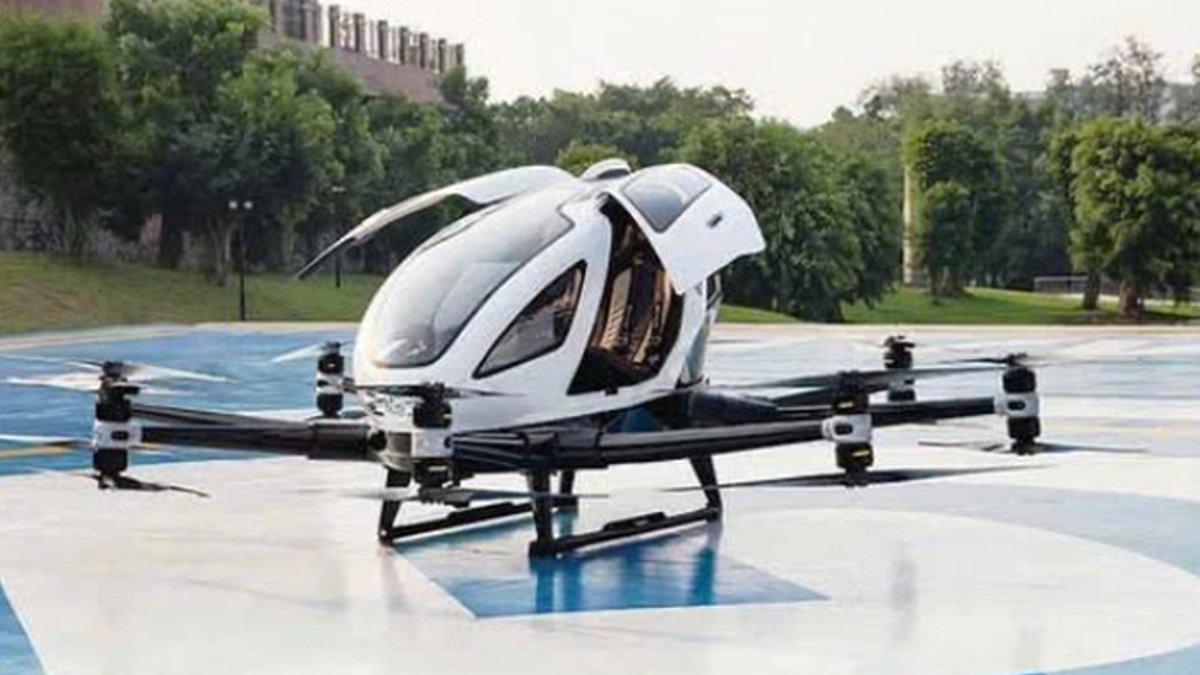
Hung Viet Technology Investment and Trading JSC and the Hanoi Department of Science and Technology formalized a partnership on Sunday, outlining plans to assess the feasibility of testing the EHang EH216-S—a pilotless electric aircraft—for both passenger and cargo transport in controlled settings.
Vietnam eyes first pilotless air taxi
The pact calls for a joint effort to develop an unmanned aircraft traffic management model and an operations control center inside a high-tech park. The center would monitor flight paths and coordinate multiple vehicles, allowing the system to respond quickly to changing conditions.
Should the trial prove viable, officials will explore a commercial-operation framework. Hanoi also intends to set up an eVTOL operations hub, train staff, and draft technical standards, regulations and safety requirements.
Design and performance of the EH216-S
The EH216-S is a two-seat electric vertical take-off and landing craft built by the Chinese firm EHang. It relies on electric motors, GNSS navigation and preset routes to fly without an onboard pilot.
At 1.93 m tall and 5.73 m wide, the aircraft weighs a maximum of 620 kg. Its carbon-fiber composite fuselage and gull-wing doors keep weight low while housing a coaxial-rotor system that enables vertical lift.
Manufacturers list a top speed of 130 km/h and a range of roughly 30 km. A smart battery supports fast charging, making the vehicle suitable for short urban hops, nearby-area links or aerial tourism.
Because the vehicle can take off and land vertically, it does not need traditional runways, a feature that aligns with dense city environments.
Read Also: PNJ to cut dividends, close stores amid restructuring, losses
eVTOL designs like this one aim to reduce ground-traffic congestion by providing point-to-point aerial routes.
Safety systems and certification history
EHang says critical components such as flight control and propulsion include multiple redundancy layers. If a part fails, a backup system can assume its function, and it continuously monitors its status.
Encrypted communications link the craft to ground systems, allowing the command center to issue emergency instructions or initiate a safe landing if needed.
The model underwent a certification program in China lasting more than 1,000 days, covering over 500 evaluation items and more than 40,000 test flights. It earned a type certificate from the Civil Aviation Administration of China in October 2023.
A production certificate followed in 2024, and the first operators received air-operator certificates for passenger service in March 2025. EHang claims the EH216-S is the world’s first pilotless passenger-carrying eVTOL to reach commercial-operation status.
By August 2026 it had logged over 90,000 flights across dozens of countries, including the United States, Spain, Thailand, South Korea, Japan and the United Arab Emirates.
The September 28 agreement represents only an exploratory step. The parties must still complete a pilot program, submit it for local approval and secure any required licences before any commercial service can launch in Vietnam.